Wednesday, August 7, 2013

GMO Rice Won't Fix a Broken World


After witnessing first hand the evidences of a frail and collapsing food system in parts of Asia, my ears perked up at the mention of another GMO rice debate. Anna Lappé shared the video below in her Facebook feed yesterday, and I couldn't help but watch (skip to 3:36 for the GMO rice exchange):


It's refreshing to hear a fourteen year old armed with a bit of knowledge intelligently counter the feel-good, save-the-world-with-technology arguments from GMO proponents...
"Let's say you weren't as lucky as you are, you were born in an Asian country, you're 14 years old, your only food was rice that had no Vitamin A in it, you're going blind and then you died," O'Leary said. "Five-hundred-and-fifty-thousand people your age die that way every year. And a company like Monsanto could come along and offer you a genetically-modified rice that includes Vitamin A that could save your eyesight and your life."

Parent was unfazed.

"Golden rice was scrapped because it didn't work. And in order for the average 11-year-old boy to get enough Vitamin A from rice he would have to eat 27 bowls of rice per day," she said. "The reason there is blindness isn't because there is a lack of Vitamin A in the rice, it's because their diets are simply rice."

"Rachel Parent Debates Kevin O'Leary About GMOs" - Huffington Post Canada 

I'm offended when I hear how easily people brandish "save the starving" arguments in the same breath as praises for genetically modified foods.

Let's be honest: bypassing holistic solutions is better for big business' bottom line.

Let's market foods fortified with artificially increased levels of nutrients so that we won't have to solve the bigger picture of a broken food web.

Let's capture developing nations' farmers in a net of loans, seed contracts, and indebtedness to the Monsanto-moneymakers of the world so that we won't have to come alongside and help them truly break cycles of poverty and oppression.

Let's let our technology to save us. If we can pay scientists to alter the fundamental genetics of a plant and then patent and sell that source of salvation, why not pocket a few extra million and wear a shiny halo of pseudo-philanthropy?

Fishermen of the Tonlé Sap:
"The inland fisheries supported by the Tonle Sap Lake system
form the backbone of Cambodian food security,
however the people of the Tonle Sap Area experience
the highest incidence of poverty in the country…" -Read More
Traditional Rice Noodles
Fresh Cambodian Market Produce

My blood pressure's up.

It's time for me to re-listen to Deconstructing Dinner's "Biotechnology Myths."


More Information:

Kevin O'Leary - Canadian Businessman
Rachel Parent - Founder of Kids Right to Know Club

Can GMOs Help End World Hunger?
...I also found it interesting that Monsanto and cohorts spent $50 million on the golden rice ad campaign. That’s more than they spent on developing the rice in the first place. Imagine if that money had been spent on irrigation projects in sub-saharan Africa. Or given as microloans to start-up farmers in Southeast Asia. At the end of the day, Monsanto’s main objective isn’t solving world hunger. It’s making money. They invest millions of dollars in developing GM crops so they can patent them and recoup their investment. There’s nothing inherently wrong with that desire. It’s the goal of any business... But don’t let a snazzy PR campaign fool you. “Despite the PR, Monsanto’s goal is not to make hunger history. It’s to control the staple crops that feed the world.”

The Golden Rice: An Exercise in How Not to Do Science
...In conclusion, the ‘golden rice’ project was a useless application, a drain on public finance and a threat to health and biodiversity. It is being promoted in order to salvage a morally as well as financially bankrupt agricultural biotech industry, and is obstructing the essential shift to sustainable agriculture that can truly improve the health and nutrition especially of the poor in the Third World. This project should be terminated immediately before further damage is done. 
Mama Natural: How to Avoid GMOs (For Real)
A quick guide to sourcing non-GMO foods (including "On A Budget" recommendations).

No, Really. Listen to Deconstructing Dinner's "Biotechnology Myths" podcast.

Lastly, a few (semi-)related stories from my time in Southeast Asia:
Visiting the Floating Villages of Cambodia
Frogs and Eels and Pig Heads


All for now.
Enough drama for one day.
xx Bethany

Monday, July 15, 2013

A New Online Home for the PDX Food Swap

Hello friends ~ I hope this note finds you well!

A little heads up to let you know the new home of the PDX Food Swap is up and running:


Spreading Food Swap Love Since 2010!
web: pdxfoodswap.com
twitter: @pdxswappers
facebook: facebook.com/pdxswappers
 
instagram: #pdxfoodswap


Update your bookmarks (wait, who uses bookmarks anymore?). 

If you're game, try my new personal favorite and add the new site to your Feedly account.

A Few Other Feedly Favorites:

(ahem...so you can catch the very random updates when they happen to go live...)

(for recipes + photos from my PDX Food Swap counterpart!)

(just because Sarah's food is so fun to follow...)

(thanks, Beka Pike, for pointing me toward Alana's blog)

(I've followed Shanna on Twitter for a long while and enjoyed her journey)

(simply lovely.)


Looking forward to seeing you at the next PDX Food Swap, and perhaps at the next informal Sustainable Food for Thought Food Group get together?

Sunday, July 14, 2013

Raw Milk Baby + Babes at Champoeg Creamery

My husband Ted earned all sorts of brownie points last weekend.

First, he sent my seven-months-pregnant self to go chill out in the air conditioned bedroom and proceeded to clean the entire (slight-disaster-of-a-)kitchen. Then he packed the half gallon mason jars and cooler in the back of the car and took charge of the multi-stop road trip that included our bi-weekly visit to Champoeg Creamery. And once we stopped in at the farm, he managed to snap a (dare I say cute?) picture of my baby-belly + the new calf...and captioned his image "Babes."
 

I mean, really? The cuteness of new life? Unstoppable.

Seriously, we celebrated our seventh anniversary a few weeks ago, and I still think Ted's the best, and I love sharing this crazy life together...

On a more serious note, I'd like to mention that my little Peach (growing more every day - due September 18th!) is a raw milk baby, and I'm so grateful for a trustworthy dairy farmer who holds herself to impeccable standards and makes it possible for me to make the educated choice to drink raw milk during pregnancy.

...Both raw and pasteurized milk harbor bacteria but the bacteria in raw milk is the healthy bacteria of lactic-acid fermentation while the bacteria in pasteurized milk is the bacteria of spoilage. And the overall bacteria count of milk produced under clean conditions is much lower than that of pasteurized milk. Both raw and pasteurized milk contain E. coli, normally a benign microorganism. The most likely source of the new strains of virulent E. coli is genetically engineered soy, fed to cows in large commercial dairies. If there is any type of milk likely to harbor these virulent breeds, it is commercial pasteurized milk.

Back in the days when scientists at our universities did real research, they compared the health of children fed raw or pasteurized milk. Children fed raw milk have more resistance to TB, scurvy, flu, diphtheria, pneumonia, asthma, allergic skin problems and tooth decay. In addition, their growth and calcium absorption was superior.
-Is Raw Milk Safe for Babies? | Sally Fallon Morell

Everywhere I turned for research and information about the safety of raw milk during pregnancy was negative...
CDC Data: Raw Milk Safe During Pregnancy | The Healthy Home Economist

If you’re going to drink raw milk, then knowing the diet and living conditions of the animals it came from is crucial. This is the reason the FDA and big dairy companies don’t want you to know that clean raw milk is actually safe – it requires healthy animals and sanitary dairies. I don’t know about you, but clean milk from healthy animals is the only milk I want to drink...
Why I Drink Raw Milk | Eat Naked Now

Resources:
If you're only just beginning to toy with the idea of raw milk, check this quick comparison on the difference between Conventional, USDA Organic, and RAW USA Certified Milk, and if you're interested in learning more about real food during pregnancy, let me suggest Nina Planck's Real Food for Mother and Baby. I gave a copy to my Sustainable Food for Thought partner in crime, Emily, when she was expecting her first child, and I was so glad to give it another read when I became pregnant...


Local Raw Milk Tidbits:

price raw milk sustainable

My raw milk farmer (and first-cousin-once-removed), Charlotte Smith of Champoeg Creamery, is now running a project to educate and train high-quality raw milk dairy farmers and responsible customers. Her messages are important, and I wholeheartedly believe in what she's doing.

Are you a raw milk producer in Oregon? (Or anywhere, for that matter?)

Are you a raw milk customer?

Do you desire to participate in a more
wholesome
&
holistically sustainable
food system? 

I'd encourage you to check out Charlotte's most recent video and engage in the fascinating conversation in her comments section.


Lastly, speaking of brownie points...if your summertime garden is overflowing with zucchini and your chocolate craving levels are high, let me leave you with the flashback to the Yogurt, Honey, and Whole Wheat Brownies that we enjoyed along with our early glasses of raw milk...

xx
Bethany

Thursday, May 30, 2013

What Life Looks Like This Spring...

Hugs and a happy, happy springtime to you, wherever in the world you are! It's been many sunrises and sunsets since I've shared updates in this space...so here's a quick peek into recent months:

Oregon sunshine and lunch in the field...

These days, life escapes the computer.

On-the-ground, in-the-kitchen, through-the-weeks...photos are only sometimes snapped.

Mental scribbles for future posts get sticky-noted to the sidewalls of my brain...and they grow a little old, a little dusty, then the adhesive gives out and the imaginary yellow squares flutter away...

So it is, home from the great world beyond.

Learning how to settle again.

Learning how to grow a new life, in more ways than one

***

After five months spent sharing life and meals and kitchen duties with my family in the rural countryside (waking to views of agricultural fields spread wide beneath Mount Hood), Ted and I found a home back in our favorite Portland neighborhood (Montavilla!), and just a week and a half ago, we regained possession of our first permanent address in 18 months.


Home, sweet home.

This also means: first permanent kitchen in a year and a half!

We're unpacking bins and boxes. Pulling out the cookware that hasn't seen daylight since Thanksgiving of 2011...

I'm reassembling staples: flours, beans, those little bulk bags of ground cumin and turmeric and paprika... (Of course I was giddy when Marissa from Food in Jars invited me to pin on her new Herb & Spice Storage board; I've got serious kitchen nesting to do and I need all the inspiration I can get.)

I'm all ears, following developments of the Montavilla Food Co-op and getting ready to jump back into the Montavilla Food Buying Club.

Lindsay (from the lovely Rosemarried.com) and I have been working on a new series of PDX Food Swaps and hope to have a new site and set of resources rolled out soon...

Vestal Community Garden Plot

I'm grateful to be once again tending my Vestal Community Garden plot.

Many thanks to my friend Allison for taking the helm during 2012 and returning the plot to me with even better soil and even bigger herbs! Just last month, kiddos from the school came out and harvested volunteer raspberries that hopped the path and sprung up in my territory... The little patch of land keeps giving and giving.

Pregnant with Baby Oregonian!

So...
New home, new kitchen, new little life squirming and dancing in my belly.
 Same garden, same city, same love for all things local and nourishing.
Balancing online and offline living...

If you're in Portland, come say hello at the next Food Swap...or maaaybe the next Food Group? Who knows? With a new living room, I may just be able to open my doors and invite you over to my place sometime soon :)

xo,
Bethany


A note: My cousin Charlotte at Champoeg Creamery is hosting a terrific Farm Camp this summer for 6-12 year olds who are ready to spend a week learning about the honest-to-goodness roots of real food.

If your kiddos are interested in milking cows, making cheese and ice cream, learning about raising turkeys and chickens and gathering eggs, getting their hands dirty planting plants in Oregon soil, quizzing bees, and learning to brush, saddle, lead, and ride horses, then visit Charlotte's blog for details: http://champoegcreamery.com/farm-camp-july-15-19-2013

**As of 5/28/2013, there are only three spots left for the July 15-18 session.**

Wednesday, March 27, 2013

PDX Food Swap: April 14th, 2013

Registration is Now Open for the PDX Food Swap!


SUNDAY,  APRIL 14th (4-6 pm) 
Hosted by Rosemarried & Sustainable Food for Thought at The Art Institute of Portland
 Invite Friends & Spread the Word:

Hello, swappers! We've missed you! We are thrilled to announce that registration is now open for our April swap. Please note that this swap will be held at a new location: Sharp, the restaurant at the International Culinary School at the Art Institute of Portland. Sharp is located on the corner of NW Couch and 8th.

For those of you who've attended our swaps previously, please feel free to scroll down to the registration form at the bottom. If you're new to the PDX Food Swap - hello and welcome! See below for details, and please don't hesitate to ask questions. We hope to see you all on April 14th!

What: A Food Swap is part silent auction/part village marketplace/part open house where your homemade creations (breads, preserves, infusions, canned goods, etc.) become your own personal currency for use in swapping with other participants. What better way to diversify your pantry and meet a few new food-minded friends?

When: Sunday, April 14th, 4-6pm

Where: Please note the new location!!! Sharp, the restaurant of the International Culinary School at the Art Institute of Portland. Sharp is located at the corner of NW Couch and 8th in downtown Portland.

What: Bring an assortment of your homemade edible specialties (and even a few non-edibles, such as: lip balm, soaps, etc.) to exchange for other handcrafted delights. We will provide swapping cards, name tags, and organization for the event. You will be given the opportunity to offer trades in a silent-auction type format, and you will be free to choose which trades to accept for your products. Bring as much or as little as you like; there are no caps or minimums.


Who: Pacific Northwesterners {aka the Willamette Valley, the Portland Metro Area, and our Neighbors to the North}. Please note, we are unable to provide childcare for this event.

Cost: Swap participants will be given free entry; a donation jar will be available to help cover the cost of supplies. (Or, better yet, donate one of your hand crafted goods!)


{How?}

a) RSVP below with your name, contact info, & description of items you plan to trade.

Make sure to register early! Due to limited space, we are capping the number of swappers at 30 and will maintain a waiting list. The last few swaps have filled up quickly, so make sure to fill out the registration form as soon as possible.

b) On Sunday the 14th, please bring your hand crafted good. Please arrive promptly at 4pm and be ready to swap shortly thereafter (we generally start on time and things move quickly!). Please do not arrive early, as there are other events happening in the space that day. Lastly, feel free to bring samples of your goods for others to try.

c) It's as simple as that! We’re excited as always to meet one another and celebrate the bounty of the seasons and the fruits of our labor. If you have any questions about the swap, please refer to this handy list of FAQs.


Registration is now open for the April 2013 Food Swap. Please fill out the form below if you would like to attend. We will send out a confirmation email within a week of your registration.


(If you have any questions, please contact lindsay.strannigan@gmail.com)

Thank you! - Lindsay, Rosemarried.com

Tuesday, January 8, 2013

On the Benefits of Pastured Chicken Eggs


Today's bounty from the henhouse
Along with raw milk and fermented dairy products, eggs from pastured chickens are one of the most nourishing foods on the planet.  Dr. Natasha Campbell McBride compares raw egg yolk to human breast milk because it can be absorbed almost 100% without needing digestion.  Egg yolks will provide you with the most essential amino acids, many vitamins (B1, B2, B6, B12, A, D, biotin), essential fatty acids, zinc magnesium and numerous other nutrients. 

We have a whole batch of young chickens hatched late spring here on the farm that just started laying and we once again have eggs for sale in the milk fridge.  You can tell from their vivid yellow-orange yolks that the chickens are eating their traditional diet of bugs, slugs, worms, even the occasional mouse or frog, supplemented with organic feed that is soy and corn free.  All these nutrients translate to a rich store of health enhancing carotenes.  The more carotenes, the darker, deeper orange color the yolk—and the higher the levels of fat-soluble vitamins as well. Eggs from pastured chickens also provide all eight essential protein building amino acids.

Our girls are out on green grass year round
For us parents, soft-boiled egg yolks are a great first food for baby.  Egg yolks, rich in choline, cholesterol and other brain-nourishing substances, can be added to your baby's diet as early as four months. (If baby reacts poorly to egg yolk at that age, discontinue and try again one month later.) Cholesterol is vital for the insulation of the nerves in the brain and the entire central nervous system. Since the brain is so dependent on cholesterol, it is especially vital during this time when brain growth is in hyper-speed.  Choline is another critical nutrient for brain development.

Store bought eggs on the left, eggs from our pastured chickens right
Why just the yolk for babies? The white is the portion that most often causes allergic reactions, so wait to give egg whites until after your child turns one.

In years past eggs have gotten a bad rap and if you listen to mainstream media you probably were scared to eat more than a couple eggs a week.  There is a great body of scientific evidence explaining how the body produces cholesterol as it's needed, to make up for what your diet doesn't supply.  Eating foods rich in cholesterol takes some of the work load off your body and even if you religiously follow a completely cholesterol-free diet, you will still have a lot of cholesterol in your body.  Your body has mechanisms in place to balance the cholesterol levels in your blood, whether you get it from food or it's produced by your body. Some people's natural, healthy cholesterol level is higher than others and a healthy body will balance this. 

Best idea yet - try to keep a few of your own hens in your yard so you always have an abundant source of nutrient dense eggs to eat or barter, or find a friend willing to house chickens for both of you. 

Truly pastured chicken eggs are hard to find but worth every effort to attain them! 

Charlotte Smith
@champoegcreamry
www.champoegcreamery.com
Charlotte passionately believes in the health benefits of a traditional foods diet, especially dairy products from grass-fed cows. She loves sharing time honored traditions of transforming milk into delicious and nutritious cheeses through her classes which also teem with nutrition facts and wisdom. Charlotte owns Champoeg Creamery, a pasture based raw milk dairy in St. Paul, Oregon, and is the mother of 3, a certified Nutrition Wellness Educator, and sits on the Executive Advisory Council for the Raw Milk Institute.


Wednesday, November 28, 2012

WINTER PDX FOOD SWAP: December 16th, 2012

Registration is Now Open for our Winter Food Swap!

SUNDAY,  DECEMBER 16th (4-6 pm) 
Hosted by Rosemarried & Sustainable Food for Thought at Abby's Table in SE Portland


Invite Friends & Spread the Word:

It's that time again: the Winter PDX Food Swap is upon us! We think this is a perfect time of year to hold a swap -- just in time for the holidays and gift-giving! 

For those of you who've attended our swaps previously, please feel free to scroll down to the registration form at the bottom. If you're new to the PDX Food Swap - hello and welcome! See below for details, and please don't hesitate to ask questions. We hope to see you all on December 16th!

What: A Food Swap is part silent auction/part village marketplace/part open house where your homemade creations (breads, preserves, infusions, canned goods, etc.) become your own personal currency for use in swapping with other participants. What better way to diversify your pantry and meet a few new food-minded friends?

When: Sunday, December 16th, 4-6pm

Where: Abby's Table, 609 SE Ankeny Street, Portland, OR 97214

What: Bring an assortment of your homemade edible specialties (and even a few non-edibles, such as: lip balm, soaps, etc.) to exchange for other handcrafted delights. We will provide swapping cards, name tags, and organization for the event. You will be given the opportunity to offer trades in a silent-auction type format, and you will be free to choose which trades to accept for your products. Bring as much or as little as you like; there are no caps or minimums.

Who: Pacific Northwesterners {aka the Willamette Valley, the Portland Metro Area, and our Neighbors to the North}. Please note, we are unable to provide childcare for this event.

Cost: Swap participants will be given free entry; a donation jar will be available to help cover the cost of supplies. (Or, better yet, donate one of your hand crafted goods!)


{How?}

a) RSVP below with your name, contact info, & description of items you plan to trade.

Make sure to register early! Due to limited space, we are capping the number of swappers at 35 and will maintain a waiting list. The last few swaps have filled up quickly, so make sure to fill out the registration form as soon as possible.

b) On Sunday the 16th, please bring your hand crafted goods and be read to swap at 4:00 pm!

c) It's as simple as that! We’re excited as always to meet one another and celebrate the bounty of the seasons and the fruits of our labor. If you have any questions about the swap, please refer to this handy list of FAQs.

d) Please note the early start time for this particular swap. Make sure to arrive at 4:00pm so we can get started on time. In addition, there will be no appetizer potluck for this swap. Instead, bring extras of the goods you plan to swap so that people can taste and sample your goods!


Registration for this event is now closed. Thanks to all who signed up, we'll see you on the 16th!

(If you have any questions, please contact pdxfoodswap@gmail.com)

Thank you! - Lindsay, Rosemarried.com

Saturday, November 3, 2012

Rescued Plums and Why Putting Up Matters

I had originally intended this post to just be about my unexpected, delightful plum harvest, but a thoughtful comment from a SFFT reader on my previous post made me realize that my surprise plums meant more to me than just something else to fill up my canning pantry.


My plums came to me by a lucky chance. One of my dear friends and SFFT reader Sara Buss had recently discovered a cluster of old plum trees at the edge of her property, after some brush had been cleared away.

I happen to have a penchant for both plums and secret gardens, so you can imagine my glee when she showed me the find.

Some of the plums were too soft and overripe to be saved, but we both came away with quite a harvest. Most of mine ended up going straight into jars, pits and all.

Whole canned plums. Recipe from the book Tart and Sweet.

The rest of them went first into my crockpot ...


...and then were blended with spices, lemon juice and sugar for plum butter.


I shared in my last post how I had foraged a single pear from an old tree growing on an abandoned lot in my neighborhood. One of our readers observed that there is a great deal of food that ends up rotting on the ground, particularly in urban areas. Meanwhile, we have a staggering number of U.S. residents who suffer from hunger. There are a multitude of complicated causes for this very sad contradiction; how we can produce an excess of food and let so many go hungry. I don't claim to be an expert on this issue and others much more qualified and informed than I am have already explored it in depth.

But what I do know, is that food matters.

What we do in our kitchens every day matters.

What we grow in our gardens, on our balconies and on our window sills matters.

The attitude we pass on to our children about their food and where it comes from matters.

And when we share what we're cooking and eating and learning with others, that matters too.

And no, I don't think my canned plums are going to solve our deeply rooted cycles of poverty and hunger.

Canning condiments in pretty jars will not change the world.

But you have to look a bit closer than that. What if it's just the act of harvesting and preserving that makes the difference? That inspires and empowers us and others to feed our friends and families? What if making use of a few dozen pieces of fruit from an overlooked tree led to an entirely different outlook on the issue of access to available food resources?  What if it helped us to see with new eyes the need for a more generous and fair food system?

That might change the world.

I love so much this inspiring post from Alana over at Eating from the Ground Up. I'll quote part of it here, but please go read the whole thing. It's perfect.

"Because those acts of filling, preserving, creating, feeding–I really do think it’s the actions themselves that create change. The jars are pretty and the contents are delicious, and that seems to me to be enough of a reason to give it a shot. But for me, the real capacity for change comes in the events that come after we fill the jar. If I can do this, what else can I do? What else can I make and create?"

Those are powerful words, friends. Let's not underestimate ourselves. If we're making and sharing and creating with eyes and hearts open to the needs among us, I think we really might just accomplish something crazy.

Like that whole world-changing thing.

Thank you again to Sara Buss for sharing her unexpected plum bounty with me! Thank you also to SFFT reader Daughter of the Glade for her thoughtful observations.


Rebekah Pike 
Rebekah is happiest with her nose in a book and enjoys making the most of her pint-sized, apartment kitchen. After leaving work in media production to become a full-time mommy, she began exploring the sustainable living movement, reconnecting with the back-to-the-earth ideals of her hippie parents. She met her husband, Darian, in 2005, working as a camp counselor in Oregon's rugged outdoors. Most of their time is spent chasing after their two year old daughter, Ashlynn, and doing serious “research” at Portland's restaurants, coffee shops and markets.

Sunday, October 21, 2012

Preparing Bone Broth from Pastured Chickens: How and Why

Our chickens on lush July pasture
Raising pastured chickens in Oregon is a seasonal endeavor, beginning with chicks sometime in the spring and butchering the last birds by the time the grass is starting to slow its growth.  Different grass varieties grow at different rates throughout the year, but a good rule of thumb for our local pasture grasses is that it grows fastest between 50-72 or so degrees Fahrenheit.  This means we are just completing our last butchering for the year and coincidentally, it coincides with soup and stew season.  We always have lots of stewing chickens available which make the most wonderful soup stock!

I've been making soup stock/bone broth for the past 25 years, and learned from watching my mom in the kitchen with her soup pot bubbling and the wonderful aromas of herbs and aromatics filling the house for 24 hours. It wasn't until the last few years that I actually found out why bone broths are so important in our diet and I began researching this wonderful and simple food.

Now we have science that validates what my mother and her mother knew intuitively - rich, homemade chicken broth helps cure colds.  It helps with digestion - the gelatin in the stock aids in the digestive process and stock contains minerals in a form the body can absorb easily—not just calcium but also magnesium, phosphorus, silicon, sulphur and trace minerals. It contains the broken down material from cartilage and tendons--stuff like chondroitin sulphates and glucosamine, now sold as expensive supplements for arthritis and joint pain.  The Weston Price Foundation recommends you begin each meal with a small bowl of bone broth based soup.

I also wondered why sometimes my stock gelled and sometimes it did not.

Sarah Pope of "The Healthy Home Economist" has a bog post on "5 Reasons Your Stock Won't Gel" and I've pasted it below:
  1. The stock rolled at too high a temperature.  If stock is simmered too high, the heat will break down and destroy the collagen.  To see what the perfect simmer on your stock should look like, see my short video on my website.
  2. The stock did not roll long enough.  Once you get that perfect simmer or “roll” going, be sure that chicken stock rolls for 6-24 hours and beef stock for 12-50 hours.  Less than that will likely not draw enough gelatin into the stock from the bones.
  3. Not enough of the right kind of bones were used that yield gelatin.  To get the right mix of bones that yield gelatin versus other types of bones that add flavor and color, make sure you use one of the following methods:  1 whole, free range layer hen with neck and wings cut up, 3-4 lbs of boney chicken parts which includes a combo of necks, backs, and wings, OR the picked carcass of 2 meat chickens.  For beef stock, use about 7 lbs bones total (4 lbs of boney bones and 3 lbs of meaty bones).
  4. Too much water was used in proportion to the bones.  For chickens, the correct proportion is 3-4 lbs of bones per 4 quarts of filtered water. For beef stock, the correct proportion is 7 lbs of bones per 4 quarts of water or more to cover.
  5. Using bones from battery chickens or chickens raised in cages.  Conventionally raised chickens or chickens raised in cages typically yield little to no gelatin.   It is worth the extra money to get quality when you buy meat especially if you will be using those bones to make stock
I thought it is interesting that store bought chickens not raised on pasture do not have enough gelatin.  We have a freezer full of USDA butchered pastured stewing chickens available for purchase just for this purpose!

Chicken Stock - from the Weston A. Price website
1 whole free-range chicken or 2 to 3 pounds of bony chicken parts, such as necks, backs, breastbones and wings*
gizzards from one chicken (optional)
2-4 chicken feet (optional)
4 quarts cold filtered water
2 tablespoons vinegar
1 large onion, coarsely chopped
2 carrots, peeled and coarsely chopped
3 celery stalks, coarsely chopped
1 bunch parsley

*Note: Farm-raised, free-range chickens give the best results. Many battery-raised chickens will not produce stock that gels.

If you are using a whole chicken, cut off the wings and remove the neck, fat glands and the gizzards from the cavity. Cut chicken parts into several pieces. (If you are using a whole chicken, remove the neck and wings and cut them into several pieces.) Place chicken or chicken pieces in a large stainless steel pot with water, vinegar and all vegetables except parsley. Let stand 30 minutes to 1 hour. Bring to a boil, and remove scum that rises to the top. Reduce heat, cover and simmer for 6 to 8 hours. The longer you cook the stock, the richer and more flavorful it will be. About 10 minutes before finishing the stock, add parsley. This will impart additional mineral ions to the broth.

Beautifully gelled broth.

Remove whole chicken or pieces with a slotted spoon. If you are using a whole chicken, let cool and remove chicken meat from the carcass. Reserve for other uses, such as chicken salads, enchiladas, sandwiches or curries. Strain the stock into a large bowl and reserve in your refrigerator until the fat rises to the top and congeals. Skim off this fat and reserve the stock in covered containers in your refrigerator or freezer.


Cooper is our charismatic and loyal chicken guardian,
protecting them from predators day and night
Austin catches this bad boy to ready him for the freezer
Marc and Charlotte, farming to provide
our community with nutrient dense food.

Charlotte Smith
@champoegcreamry
www.champoegcreamery.com
Charlotte passionately believes in the health benefits of a traditional foods diet, especially dairy products from grass-fed cows. She loves sharing time honored traditions of transforming milk into delicious and nutritious cheeses through her classes which also teem with nutrition facts and wisdom. Charlotte owns Champoeg Creamery, a pasture based raw milk dairy in St. Paul, Oregon, and is the mother of 3, a certified Nutrition Wellness Educator, and sits on the Executive Advisory Council for the Raw Milk Institute.

Tuesday, October 9, 2012

Thoughts on Fall Food Preservation

So far, fall around here has been pretty much perfect - warm, sunny days and evenings with just enough nip in the air to let you know that although summer may be lingering, cold weather isn't far off. Summer always starts off slow here in the Pacific Northwest ... we often have cool weather all through June and sometimes the first part of July, so the sudden and bountiful September harvest always seems to surprise me from year to year.  


{My canning pantry}


The farmers' markets and farm stands seem to suddenly explode with variety - tomatoes, corn, apples, plums, pears, potatoes, squash - and suddenly I'm scrambling to keep up!

I was once again the lucky recipient of a TON of Barlett pears from my in-laws; three large grocery sacks full! No idea how many pounds exactly, but I'd estimate 30-40. My typical long, slow cook-down into pear butter wasn't going get them into jars fast enough this year, so I canned slices in a honey-vanilla syrup, following a recipe from Tart and Sweet. After a while, I was going through honey so fast, that I decided to switch to a simple sugar syrup instead. Some were already overripe and I couldn't save them, but I rescued enough to come out with a respectable number of pint jars.

{Pear slices suspended in honey syrup, with vanilla and cinnamon}


After the pears came the apples, which I actually canned into applesauce with my mother-in-law, in her kitchen. Again, SO MANY APPLES. I can't even guess at how many. Craziness. It took a while to find a good rythym, but after we did, it seemed to go fairly quickly and two people working in the kitchen made the process much faster. So the outcome of that was a wealth of both applesauce and apple butter, plus two quarts of apple pie filling, all of which will be much appreciated during the gloomy months of winter!

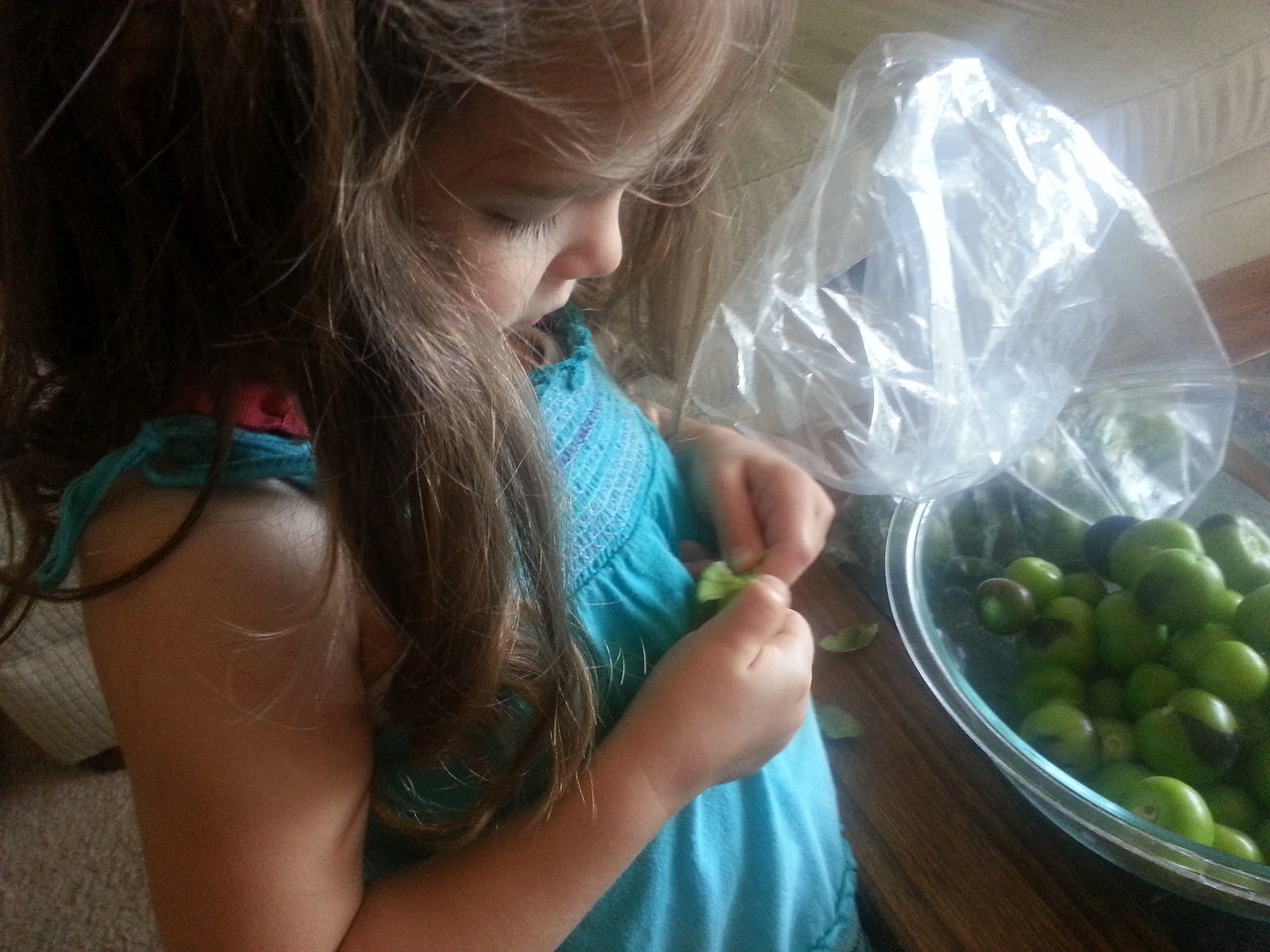
Inbetween, I squeezed in a batch of tomatillo salsa, which I froze instead of canning it. I prefer the freezer for certain things, so that I don't have to abide by a tested recipe for the sake of acidity levels and such. And I enlisted my three year old to help me peel the tomatillos, which she found utterly fascinating.


{My little kitchen helper}
So combined with the food projects from early summer, we have a cupboard full of blueberry jam, peach slices (shared with us from the in-laws), pear slices, canned whole plums, plum butter, applesauce, apple butter and apple pie filling, plus the strawberry jam, blueberries, blackberries and tomatillo salsa that I have in the freezer!


 It's the most canning and putting up that I've ever done in a year, so I'm feeling pretty accomplished!

Okay, your turn to brag: what have you been up to in the kitchen this past summer and fall?

P.S. After getting a tip from my neighbor yesterday, my little girl and I went out searching for an old pear tree, that was supposedly growing just across the road from us in an abandoned lot. We found one, perfect pear that was growing low enough for us to reach. The rest were overripe and too high up, but I'm looking forward to getting out there a bit earlier next year! Such a fun little adventure and such a pretty gift from that long-forgotten old tree.


Rebekah Pike 
Rebekah is happiest with her nose in a book and enjoys making the most of her pint-sized, apartment kitchen. After leaving work in media production to become a full-time mommy, she began exploring the sustainable living movement, reconnecting with the back-to-the-earth ideals of her hippie parents. She met her husband, Darian, in 2005, working as a camp counselor in Oregon's rugged outdoors. Most of their time is spent chasing after their three year old daughter, Ashlynn, and doing serious “research” at Portland's restaurants, coffee shops and markets.


Wednesday, September 12, 2012

Back to School - Lunch Time!


Once again another summer has flown by way too quickly and I realize school time is here already!!  Mornings are hectic around here - everyone needs to be washed and combed and dressed and fed and brushed and out the door by 7:15, so I can go milk cows.  In the midst of all this chaos we still need to plan ahead for lunchtime, too.

There are many attempts around the U.S. to make school lunches healthier - but most schools are still like our local school and have a very small budget to work within, which means heavy on the carbs and starches and processed foods to remain within budget.  For those of you trying to eat a traditional foods diet this can be frustrating.  Many of us working moms would love the convenience of school lunches but know we have to prioritize our children's health.

You also have to consider your kid's personality - are they the type that has to fit in and doesn't want to be different so therefore has to have the same hot lunch everyone else is having, or will they be able to stand up for their homemade grub that doesn't come in fancy shapes with a cutesy name?  This may determine how traditional looking you make your lunches.

Shivan's lunch this week - meatballs, enzyme rich ketchup, fruit, yogurt smoothie.

Let Them Help

I have found that if my daughter gets to choose her lunch foods and helps prepare it then she has complete confidence eating it in front of all the pre-packaged and fried goodies that her friends have.  Now that she's 5 she loves to help by cutting up her own fruit and veggies and packaging them in her lunch box and she also helps make her own smoothies in the blender.  We also practice the 80/20 rule at school, just like we do at home.  If we eat a traditional foods diet 80% of the time than we give ourselves 20% leeway.  In this case I let her choose one lunch per week if she'd like to indulge in a cheeseburger or spaghetti or "chicken" nuggets.  This also gives me an "out" if we are really running late or I ran out of time to prepare for lunch.  Moms - it's ok to give yourself some grace and not be perfect every time!!

This week when I asked her what she wanted in her school lunch box she said, "meatballs, oranges, grapes and a yogurt smoothie."  Excellent choices!! I was so proud of her!  So this is what we are starting with the first week.  She helps me make kefir smoothies with honey and frozen blueberries we picked this summer and we put it in a thermos and it stays cold enough for her to drink it through a straw.  She's not a big sandwich person so meatballs or hunks of our home raised chicken is just right and she's huge on mixed fruit, especially if she can peel the little "cutie" oranges herself.

Other great options we will prepare:  steamed broccoli and carrots and some homemade hummus or ranch dressing to dip them in.  For the dip, I simply make some fromage blanc with raw milk, stir in some minced chives, parsley and garlic salt and it tastes just like ranch dressing from the store only far healthier.  If you mix the fromage blanc with a little honey it makes a nutritious and delicious fruit dip, too.  It can also be spread on bread or a tortilla for a sandwich - stack it or roll it with other goodies your child will eat. 

Sneak in the Enzymes

A challenge for me is getting enough fermented veggies in my kid's bellies - I still have to disguise them or mask them.  This week I am serving our homemade ketchup with her meatballs.  We use Sally Fallon's recipe from Nourishing Traditions which I've listed below.  Shivan also loves the homemade fermented pickles and has no idea they are full of enzymes to help start the process of digestion and reduce the strain on the pancreas.  Traditionally fermented salami slices are another healthy meat option whether on a sandwich or roll up with some fromage blanc again. Yogurt and kefir and even raw milk in a thermos will satisfy, feed the brain and the immune system!

Additional lunch box ideas:
  • hard boiled eggs, sliced plain or in sandwiches and wraps
  • homemade (or purchased :) raw milk cheeses, cubed 
  • sliced traditionally fermented salami
  • pepperoni sticks from (our) grass fed beef cow
  • muffins with grated zucchini, carrots, or sweet potato
  • sliced pita triangles dipped in hummus or fromage blanc dip
  • homemade chicken soup packed in a thermos 
  • Leftovers! - lasagna, pastas, casseroles in a thermos are all satisfying and nutritious

Lacto-fermented ketchup, rich with enzymes, is easy to make - mix the ingredients together and let ferment on the counter for a couple days.

Nourishing Traditions "Ketchup"

3 cups canned tomato paste, preferably organic
1/4 cup whey
1 tablespoon sea salt
1/2 cup maple syrup
1/4 teaspoon cayenne pepper
3 cloves garlic, peeled and mashed
1/2 cup homemade or commercial fish sauce
Mix all ingredients until well blended.  Place in a quart-sized, wide-mouth mason jar.  The top of the ketchup should be at least 1 inch below the top of the jar.  Leave at room temperature for about 2 days before transferring to refrigerator.


The Healthy Home Economist has a great recipe out this week for Lacto-Fermented Sloppy Joes using this homemade ketchup - we will definitely be eating them this week.

Make your back to school lunches delicious as well as nutritious and your kids will be equipped to fight off all those back to school colds!

Warmly,
Charlotte

Charlotte Smith
@champoegcreamry
www.champoegcreamery.com
Charlotte passionately believes in the health benefits of a traditional foods diet, especially dairy products from grass-fed cows. She loves sharing time honored traditions of transforming milk into delicious and nutritious cheeses through her classes which are also teeming with nutrition facts and wisdom. Charlotte owns Champoeg Creamery, a pasture based raw milk dairy in St. Paul, Oregon, and is the mother of 3 and a certified Nutrition Wellness Educator.


LinkWithin

Related Posts Plugin for WordPress, Blogger...